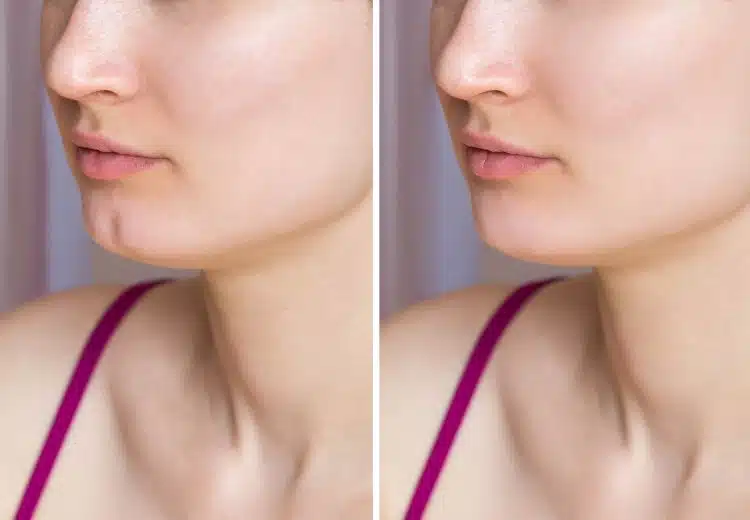
If you’re wondering how to get rid of a cleft chin, treatments such as dermal fillers, Botox, and surgery can help reduce its appearance. Dermal fillers can smooth the central indentation, while Botox may soften dimpling caused by muscle activity. For deeper or more pronounced clefts, surgical options may be considered to achieve longer-lasting changes.
The best treatment depends on your chin’s underlying anatomy, including muscle activity, soft tissue, and bone structure. While some treatments can significantly improve the appearance of a cleft chin, complete correction isn’t always possible.
Best Cleft Chin Treatments by Cause
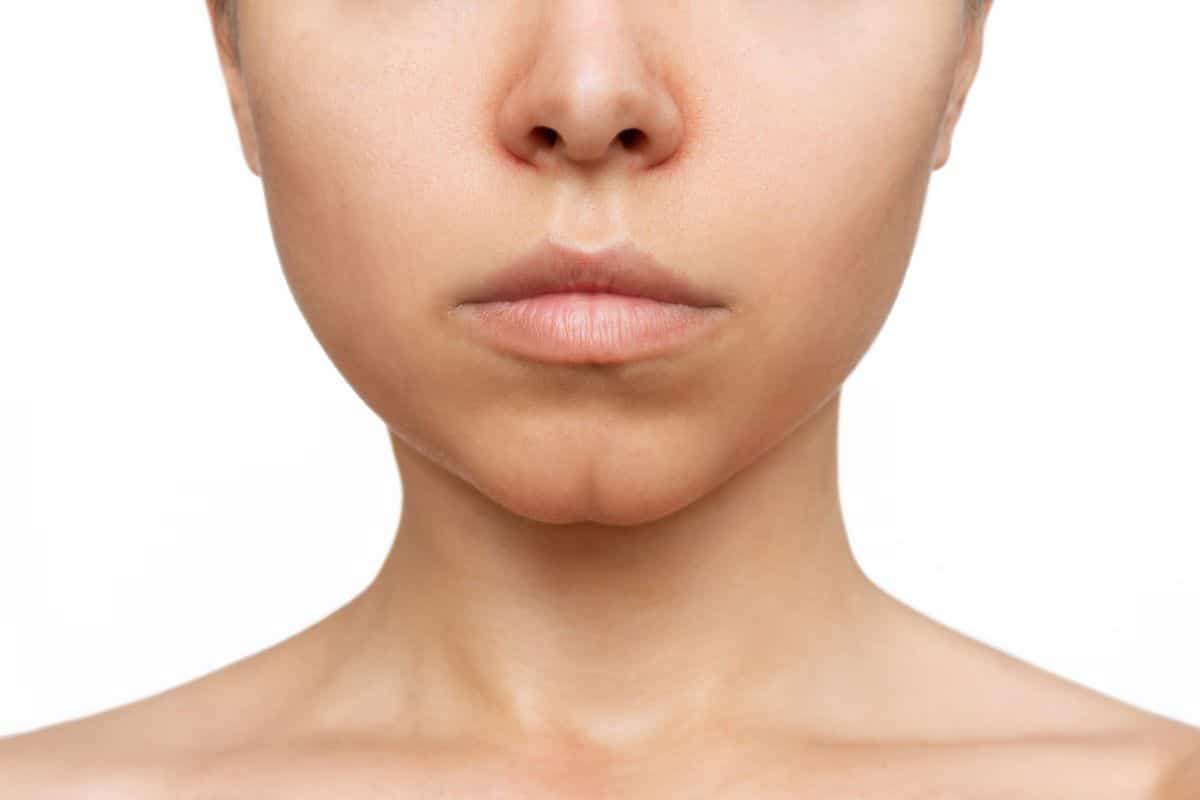
The best way to get rid of a cleft chin depends on what is causing the indentation. Different causes require different treatments, and choosing the right approach helps ensure natural-looking, balanced results.
- Deep or structural cleft chin→ Fat grafting or surgical cleft correction may be considered depending on the underlying anatomy. Chin implants may help when additional chin projection is also desired.
- Muscle-related cleft chin → Botox injections relax the mentalis muscle, which can pull the skin inward and deepen the groove in the chin.
- Soft-tissue indentation → Dermal fillers add volume beneath the skin to fill in the central groove of the chin.
What Causes a Cleft Chin?
A cleft chin is a natural facial feature caused by differences in the underlying muscles, soft tissue, and sometimes bone structure. According to a 2022 article published in Facial Plastic Surgery & Aesthetic Medicine, a cleft chin can develop due to variations in the mentalis muscles and underlying jawbone structure.
Some cleft chins remain visible even when the face is relaxed, while others become more noticeable during facial movements because of muscle activity. Understanding the cause helps determine whether dermal fillers, Botox, or surgical correction may be the most suitable treatment.
Does Treatment Depend on How Deep Your Cleft Chin Is?
Yes, the depth of a cleft chin can influence which treatment is most appropriate.
- Slight or subtle cleft chin: A slight cleft chin typically has a shallow indentation that may not require treatment. For patients who want a smoother appearance, dermal fillers may soften the groove, while Botox can help if muscle activity makes it more noticeable.
- Deep cleft chin: A deep cleft chin has a more pronounced indentation that may involve stronger soft-tissue attachments or underlying structural differences. Fillers may improve its appearance, but more complex cases could benefit from fat grafting or surgical correction.
A facial plastic surgeon can evaluate the depth and underlying anatomy to recommend the most suitable approach.
Is a Cleft Chin the Same as a Butt Chin or Chin Dimple?
Yes. A cleft chin, commonly called a butt chin, split chin, or chin dimple, refers to a natural indentation in the center of the chin. The indentation can range from a subtle dimple to a pronounced groove, and its depth and underlying anatomy influence which treatments may help reduce its appearance.
How Dermal Fillers Help Get Rid of a Cleft Chin
Dermal fillers offer a nonsurgical way to soften a cleft chin by adding volume beneath the central indentation. Sometimes called butt chin filler, this treatment can create a smoother, more even chin contour without changing the underlying bone structure.
Fillers are generally better suited for mild to moderate clefts caused by soft-tissue indentation. Deeper clefts or those associated with significant muscle activity may require additional or alternative treatments.
Results are usually visible immediately, although swelling can temporarily affect the final appearance. Depending on the filler used, results may last several months to a year or longer. Fillers can significantly soften a cleft, but they may not eliminate it.
Which Types of Chin Fillers Are Suitable for Cleft Chins?
Different fillers provide different levels of volume, structural support, and longevity. They are not interchangeable, and the most appropriate option depends on the depth of the cleft, surrounding tissue, and desired results.
Hyaluronic Acid Fillers
Hyaluronic acid (HA) fillers are often considered for softening mild to moderate chin indentations because they provide immediate volume and allow for precise contour adjustments.
- Best for: Mild to moderate soft-tissue indentations.
- Results: Visible immediately, with the final appearance assessed after swelling settles.
- Longevity: Often several months to around a year, depending on the product and individual factors.
- Recovery: Usually minimal, with possible temporary swelling or bruising.
Unlike other filler materials, HA fillers can often be dissolved using hyaluronidase if correction is needed, although reversal is not always straightforward.
Poly-L-lactic Acid Fillers
Poly-L-lactic acid (PLLA) stimulates collagen production gradually rather than immediately filling a groove. Its effects can last up to two years in some approved applications, but it is generally less suited to precise correction of a narrow cleft and may require multiple sessions.
- Longevity: Results can last up to two years as collagen continues to rebuild
- What it is: A biostimulatory filler that stimulates collagen production rather than adding instant volume
- Best for: Patients who want subtle, longer-lasting improvement and overall skin support
- How it works: Triggers collagen growth that gradually improves chin texture and softens the cleft
- Results: Develop slowly over several months
- Recovery: Minimal downtime, though multiple sessions may be needed
Calcium Hydroxylapatite Fillers
Calcium hydroxylapatite (CaHA) provides immediate volume and structural support while stimulating collagen production. It may be considered for broader chin contouring, but it is not readily dissolved like HA filler and may not be appropriate for every cleft.
Important: Although certain dermal fillers are FDA-approved for chin augmentation, their use specifically to correct a cleft chin may be off-label. A facial plastic surgeon should determine which product and approach are suitable for your anatomy.

Ready to Smooth Out Your Cleft Chin?
Book a consultation today and take the first step toward the look you want—no surgery, no downtime, just instant results!
Other Treatments to Fix a Cleft Chin
Dermal fillers aren’t the only way to reduce the appearance of a cleft chin. Depending on the underlying anatomy and desired results, Botox, fat grafting, or surgical correction may be more appropriate.
Botox Injections
Botox can help soften a cleft chin when muscle activity makes the indentation more noticeable, particularly during facial expressions. It works by relaxing the mentalis muscle, which can contribute to chin dimpling.
- Best for: Muscle-related chin dimpling.
- Longevity: Typically 3–4 months.
- Results: Smoother chin appearance without adding volume.
- Recovery: Minimal downtime, with results developing over several days.
Botox cannot eliminate a fixed structural cleft, so some patients may benefit from combining it with fillers. Its use for chin dimpling is off-label.
Fat Grafting
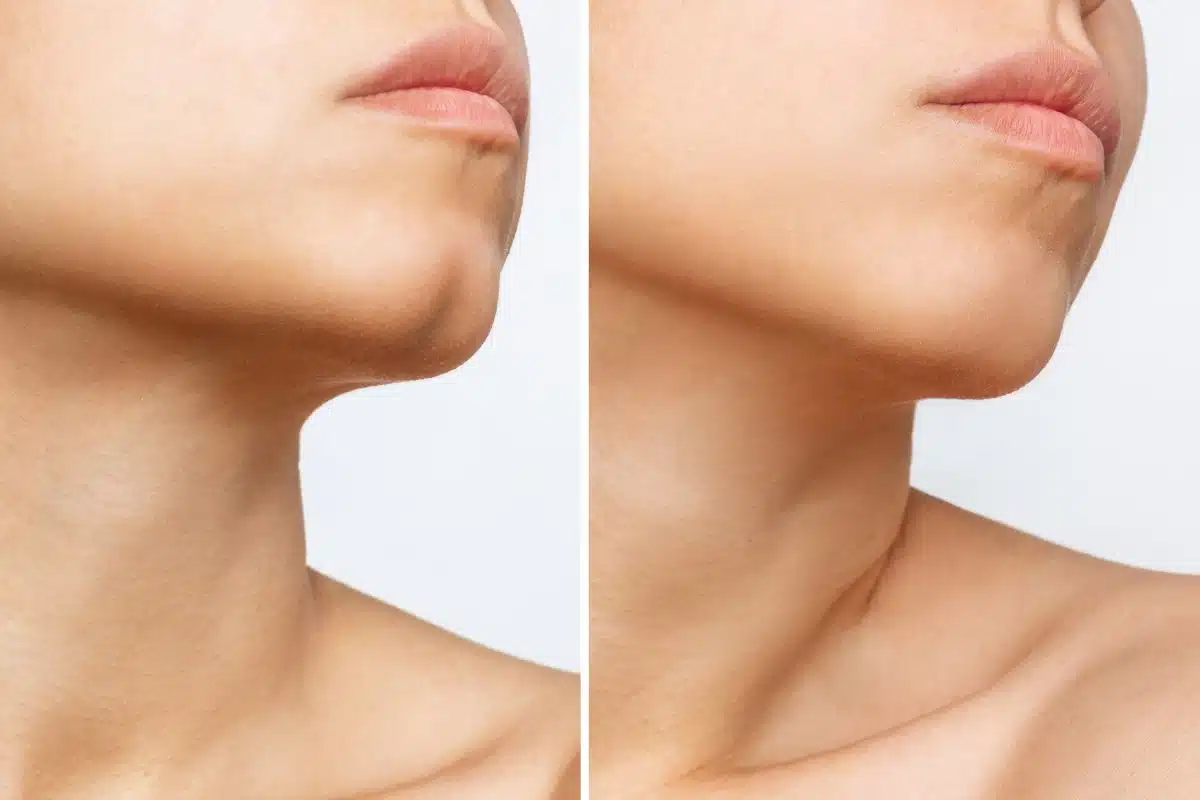
Fat grafting uses fat collected from another area of the body to add volume beneath the chin indentation. It may be considered for patients seeking longer-lasting improvement without synthetic fillers.
- Best for: Cleft chins that may benefit from additional soft-tissue volume.
- Longevity: Potentially long-lasting, although some transferred fat is reabsorbed.
- Results: A softer indentation and smoother chin contour.
- Recovery: Swelling and bruising may last several days to weeks.
Results vary depending on how much transferred fat survives, and additional treatment may sometimes be necessary.
Genioplasty and Surgical Cleft Correction
Surgical correction may be considered for deeper or more pronounced cleft chins that cannot be adequately improved with nonsurgical treatments. Depending on the anatomy, surgery may involve adjusting the mentalis muscles, underlying soft tissue, or chin bone. Not every cleft chin requires bone reshaping.
- Best for: Pronounced clefts or patients seeking longer-lasting correction.
- Longevity: Generally long-lasting.
- Results: Potentially significant improvement, although complete removal isn’t guaranteed.
- Recovery: Swelling and healing over several weeks, with final results taking longer to develop.
Chin Implants or Chin Augmentation Surgery
Chin implants add projection and improve the overall shape of the chin. They may help reduce the appearance of certain clefts, particularly when additional chin definition is also desired.
- Best for: Patients seeking improved chin projection along with contour enhancement.
- Longevity: Long-lasting, although implants may sometimes require revision or removal.
- Results: Improved chin definition and potentially a less noticeable cleft.
- Recovery: Initial recovery typically takes one to two weeks, with swelling improving gradually.
Chin implants primarily enhance chin shape and may not correct the underlying cause of a central cleft.
Cleft Chin Treatments Compared: Which Option Is Best?
The best treatment depends on the depth of your cleft chin, the underlying anatomy, and whether you prefer temporary or longer-lasting results.
| Treatment | Best For | Results Duration | Recovery | Main Limitation |
|---|---|---|---|---|
| Dermal Fillers | Mild to moderate indentations | Several months to over a year | Minimal downtime | May not fully correct deep clefts |
| Botox | Muscle-related dimpling | 3–4 months | Minimal downtime | Cannot correct a fixed structural cleft |
| Fat Grafting | Soft-tissue volume correction | Potentially long-lasting | Days to weeks | Some transferred fat may be reabsorbed |
| Surgical Cleft Correction | Deep or pronounced clefts | Generally long-lasting | Several weeks | Invasive; complete correction isn’t guaranteed |
| Chin Implants | Clefts accompanied by insufficient chin projection | Long-lasting | Initial recovery of 1–2 weeks | May not directly correct the cleft |
A facial plastic surgeon can evaluate your chin anatomy and help determine which approach is most likely to achieve your desired results.
What Are the Risks and Limitations of Cleft Chin Treatments?
Although cleft chin treatments can improve facial contour, each option has potential risks and limitations.
- Dermal fillers: Common side effects include swelling, bruising, redness, and tenderness. Less common complications include lumps and infection. Rarely, accidental injection into a blood vessel can cause tissue damage or other serious complications, including vision loss.
- Botox: Temporary bruising, muscle weakness, or facial asymmetry may occur. Injections around the chin can also affect lower-lip movement if nearby muscles are weakened.
- Fat grafting: Some transferred fat may be reabsorbed, leading to uneven results or the need for additional treatment.
- Surgical correction and chin implants: Risks include infection, scarring, swelling, changes in sensation, and possible revision surgery. Implants may also shift or require removal.
Results vary depending on individual anatomy, treatment choice, and healing. Even with surgery, complete removal of a pronounced cleft chin cannot always be guaranteed.
Schedule a Consultation for Your Cleft Chin Procedure
Choosing the right treatment for a cleft chin depends on your facial anatomy, the depth of the indentation, and your aesthetic goals. A personalized evaluation can help determine whether dermal fillers, Botox, or surgical correction may be most appropriate.
At Kam Facial Plastic Surgery, Dr. Joanna Kam, a double board-certified facial plastic surgeon, takes an individualized approach to facial treatments. She reviews each patient’s medical history, evaluates the treatment area, and discusses realistic expectations to help guide treatment decisions.
If you’re considering cleft chin correction, schedule a consultation with Dr. Kam by calling 856-565-2903 or visiting our contact page to explore your options.